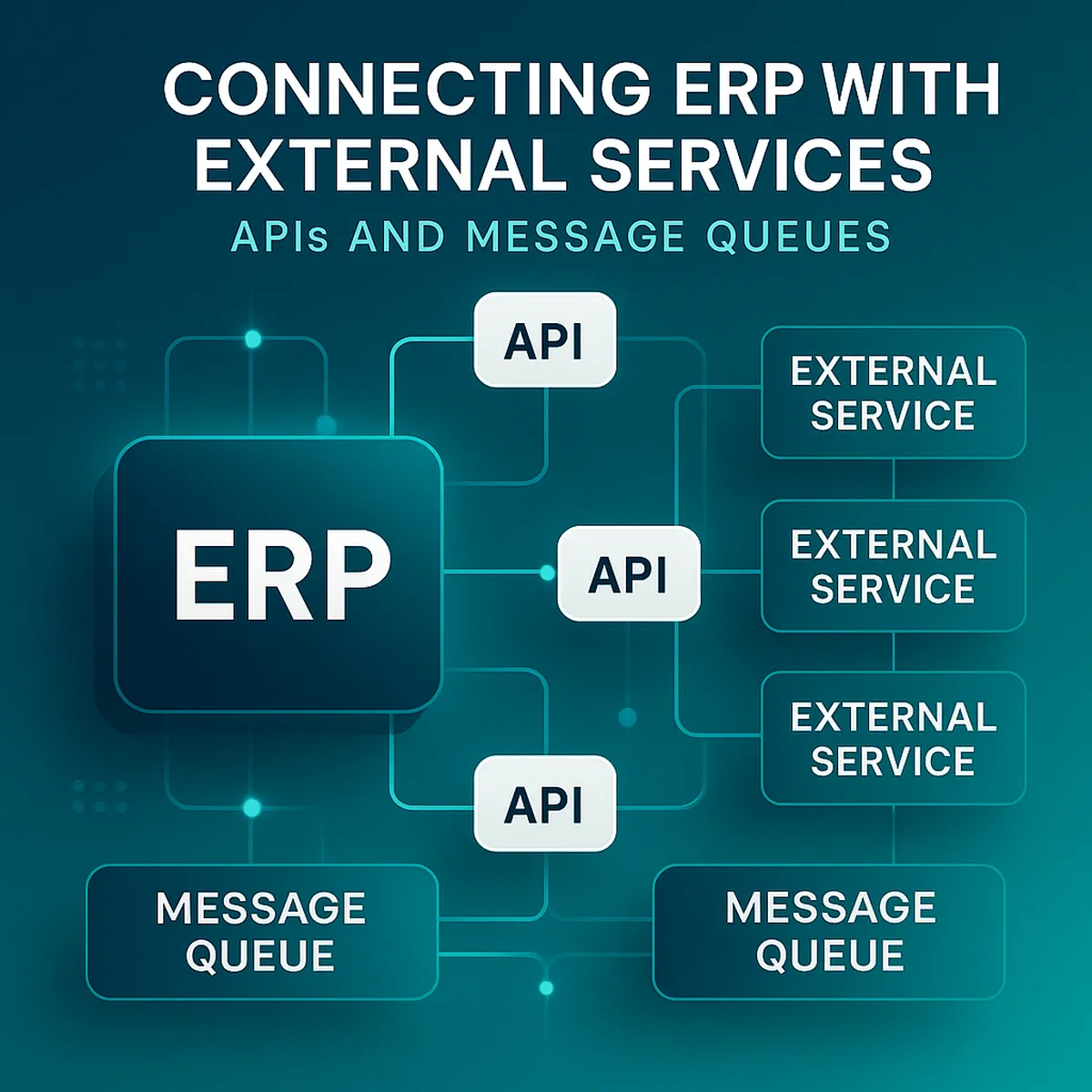
1. Why ERP integrations matter more than ever
ERP systems increasingly serve as the operational core while specialised tools handle CRM, finance, logistics or analytics. This decentralisation increases flexibility but requires stable integrations to avoid data drift, double entries and inconsistent workflows.
2. REST APIs: the default integration method
Most ERPs expose REST endpoints for CRUD operations. They are perfect for:
- customer updates,
- status synchronisation,
- document creation (orders, invoices, shipments),
- reference data imports.
Common pitfalls
- Missing idempotency — duplicate orders on retry.
- Rate limits — batch operations overwhelm the ERP.
- Timeouts — long-running business rules block API calls.
            POST /api/orders
            Idempotency-Key: 8f3ca...

            {
            "customer": "CUST-1001",
            "lines": [
                {"sku": "A-01", "qty": 3},
                {"sku": "A-02", "qty": 1}
            ]
            }
3. Message queues: solving reliability and scalability
Queues (RabbitMQ, Kafka, NATS, AWS SQS) help decouple ERP from external services. Instead of sending data synchronously, ERP emits events:
order.createdinventory.reservedpayment.completed
Consumers process them at their own speed — perfect for high-load WMS, payments or BI ingestion.
Integration traps
- No dead-letter queues → messages disappear silently.
- Improper partitions → inconsistent event order.
- Huge payloads → queues not designed for large documents.
4. API + queue hybrid architecture (recommended)
The industry trend is hybrid: use APIs for commands and queues for events.
Client → (API) → ERP → (Events) → Queue → Services
Benefits:
- fast writes through API,
- reliable async propagation through events,
- natural scaling for BI, WMS, CRM.
5. Observability: the often forgotten layer
Integrations fail silently unless monitored. A healthy integration stack includes:
- structured logs,
- message tracing IDs,
- dashboards for throughput, failures, retries, queue size.
6. Where open-source ERP fits
Open-source ERP systems such as ERPNext and Odoo provide flexible APIs and event hooks. Declarative platforms like lsFusion offer an additional advantage — predictable behaviour, automatic transaction boundaries and easy event emission via declarative rules.
Conclusion
Integrating ERP is not simply about connecting endpoints — it is about designing predictable and observable workflows. A balanced combination of APIs, queues and declarative logic ensures reliability while keeping the architecture future-proof.